
Donnchadh O'Mahony
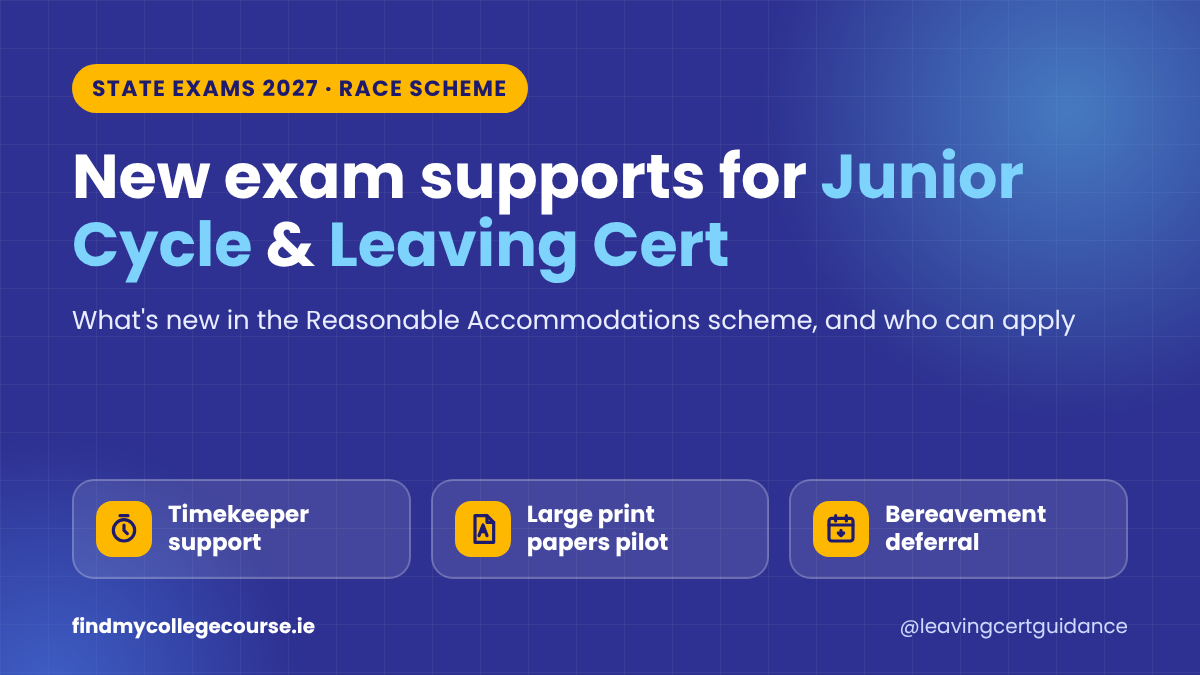
If your son or daughter is sitting the Junior Cycle or Leaving Cert in 2027 and has additional needs, there’s good news. On 10 November 2026 the State Examinations Commission (SEC) published its 2027 RACE Instructions for Schools, and with them come three new supports in the State exams. Every accommodation from 2026 also stays in place, including the extra 10 minutes per paper.
Here’s what has changed, who it’s for, and what you need to do now.
Figures from the Department of Education and Youth, November 2026.
RACE stands for Reasonable Accommodations at the Certificate Examinations. It’s the SEC scheme that adjusts how a student sits their exams so that a disability, learning difficulty, medical condition or other additional need doesn’t stop them showing what they know. The exam itself and the marking standard don’t change. What changes is the way the student gets to take it.
Familiar accommodations include a reader, a scribe, using a word processor, a recording device, a separate exam centre, and modified or enlarged papers.
Everything that was available in 2026 continues in 2027. That includes the interim additional-time measure brought in last January: students who already had a direct-intervention accommodation through RACE got an extra 10 minutes on each written paper, with no extra application needed. The SEC is keeping that measure for 2027 while it evaluates how it worked and finishes its wider review of the scheme.
Students with behavioural, attention or focus difficulties can now be given a timekeeper (in other countries this role is often called a “prompter”). The school provides this person, and their job is to help the student pace themselves. For example, they can flag that the student is spending too long on one question. For students with ADHD or similar focus difficulties, who can lose track of time on one question and run out of time for the rest of the paper, this could make a real difference.
For students with visual difficulties, the SEC is piloting modified large print papers in these subjects:
The SEC has released sample papers based on the 2026 exams so students can get used to the layout before June. These sit alongside the options already available: enlarged standard papers, modified papers (where diagrams or images may be simplified or removed), Braille, and read-only digital papers.
This one matters to every family. If a student loses an immediate family member during the exam period, they can now ask to defer all of their exams to the deferred sitting. Until now, eligible students could only apply for up to three days’ absence from the main exams.
The deferred sitting usually starts around the end of June and runs into early July. The SEC will send schools the full details of the Deferred Examinations scheme separately in 2027.
This is the part I’m asked about most. RACE is based on need, not on a diagnosis. A student doesn’t need a particular label to qualify, and having a diagnosis doesn’t automatically mean they’ll get an accommodation. The grounds are:
| Category | Examples |
|---|---|
| Learning difficulty | Dyslexia, dyscalculia or other general learning difficulties |
| Hearing difficulty | Hearing loss or impairment |
| Visual difficulty | Visual impairment |
| Physical difficulty | A broad category that can include dyspraxia/DCD and cerebral palsy, as well as sensory, behavioural and mental health conditions |
Some accommodations have their own criteria. For a learning difficulty, for example, the school has to establish it through a standardised score test plus reading, spelling and/or writing tests. The application also has to describe how the student normally works in class and the support they’ve needed in school. That’s why it’s so important that any supports your child relies on are actually used in school, and not only at exam time.
Parents and students don’t apply directly to the SEC. The school applies on the student’s behalf, using what staff know about the student’s needs and normal way of working. Usually this is led by the SEN coordinator, the guidance counsellor or the year head.
⏰ Don’t leave this late. Applications are usually due in late November for Leaving Cert and LCA students and mid-December for Junior Cycle. For the 2026 exams the deadlines were 21 November and 12 December. Check the exact 2027 dates with your school this week. If your child had RACE at Junior Cycle, ask the school about reactivating it for the Leaving Cert.
Questions to ask the school:
The SEC began a full review of the RACE scheme in 2025, which includes how much extra time students get. Instead of waiting until the review finishes, it’s bringing in changes as they’re ready. The 10 extra minutes, the timekeeper, the large print pilot and the bereavement changes all came about this way. The review is due to finish in the coming months, and I’ll update this page when it does.
For full details, schools should read the SEC’s 2027 RACE Instructions for Schools on examinations.ie. The SEC’s helpline is 090 644 2700.
Students with additional needs may also be eligible for reduced-points places and supports in college through the DARE scheme. If your child is in 5th or 6th Year, now is a good time to look at course options, the CAO and the DARE scheme together. Our interest tests and one-to-one guidance sessions can help you get started.
Sources: Department of Education and Youth: Minister Naughton confirms enhanced supports for young people sitting their State examinations in 2027 (10 Nov 2026) · Department of Education and Youth: Interim additional-time scheme (Jan 2026) · State Examinations Commission